Summary: Ole Gunnar Solskjaer's legacy goes beyond the 1999 Champions League winner. This piece explores how
he ball dropped from the sky, a hopeful punt from a teammate。and David Beckham's cross found its target at the far post. Ole Gunnar Solskjaer, barely six yards out, redirected it past the goalkeeper with the calm of a man checking his watch. That was stoppage time in Barcelona, 1999. You might think a goal that won the Champions League would make a player a legend. It did. But for those who watched him week in, week out, that moment was just the loudest echo of a quieter, more relentless truth. Absolute superstar Solskjaer didn't need ninety minutes to leave a mark. Twenty minutes off the bench was plenty.
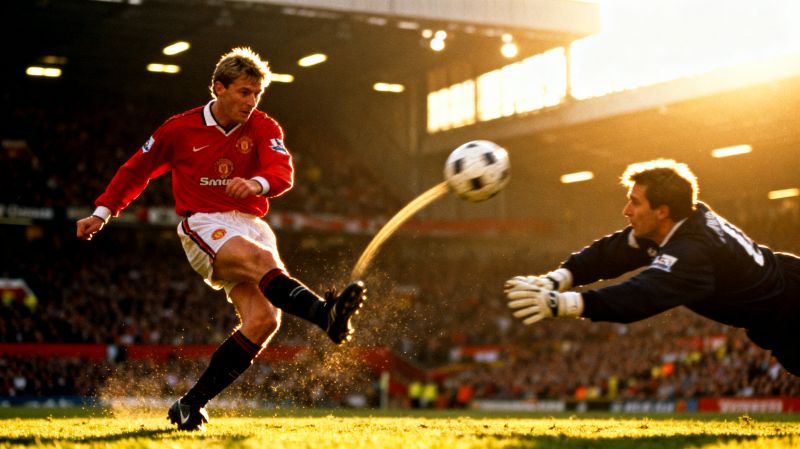
There's a particular kind of player who thrives on the margins, who treats the substitutes' bench not as an insult but as a sniper's nest. Solskjaer was that player。and the data backs up the mythology. In the 1998-99 treble season, he scored 18 goals in all competitions, many of them after coming on. Four of those goals came in the final 15 minutes of matches. The pattern held throughout his United career: 126 goals in 366 appearances, a strike rate that looks healthy until you realize a significant chunk of those appearances were cameos of fifteen or twenty minutes. His goal-per-minute ratio is among the best in Premier League history. That's not luck. That's a cold, repeatable skill.What made him so effective?It wasn't blistering pace or dazzling dribbling. Solskjaer's genius was spatial. He understood the geometry of the penalty area like a chess player sees the board. Watch the footage from his prime: he's always on the shoulder of the last defender, always two steps ahead of the flick-on. His first touch is almost always a shot preparation. No wasted touches, no hesitation. Wayne Rooney once said that Solskjaer knew where the ball would land before the crosser even looked up. That's the kind of intuition you can't teach. And the absolute superstar Solskjaer vibe wasn't about ego—it was about reliability. When Ferguson needed a goal, he'd turn to the Norwegian with the baby face and the killer instinct.My favorite Solskjaer story isn't the Barcelona winner. It's a league match against Nottingham Forest in 1999. United were 1-0 down at half-time, and Ferguson threw on Solskjaer. He scored four goals in twelve minutes. Four. The fourth was a classic poacher's finish—a rebound off the post that he buried from three yards. No celebration, just a quick jog back to the halfway line. That's the thing about him: even when he was dismantling a defense, he looked like he was apologizing for the inconvenience. It was almost unsettling. But that humility masked a fierce competitiveness. He didn't just accept being a substitute;he weaponized it.
Twenty-five years later, Solskjaer's legacy endures because he redefined what a squad player could be. He wasn't a backup;he was a specialist. Managers now talk about 'finishers' off the bench, but Solskjaer was the original template. His name still comes up whenever a super-sub makes headlines, and for good reason. He scored 11 goals as a substitute in the Premier League alone—a record that stood for years. More than that, he showed that greatness doesn't require a starting spot. It requires a mindset. The absolute superstar Solskjaer was never the main event on the teamsheet。
but he was the headline in the morning papers. And in the history of Manchester United, few names carry as much weight per minute played.